
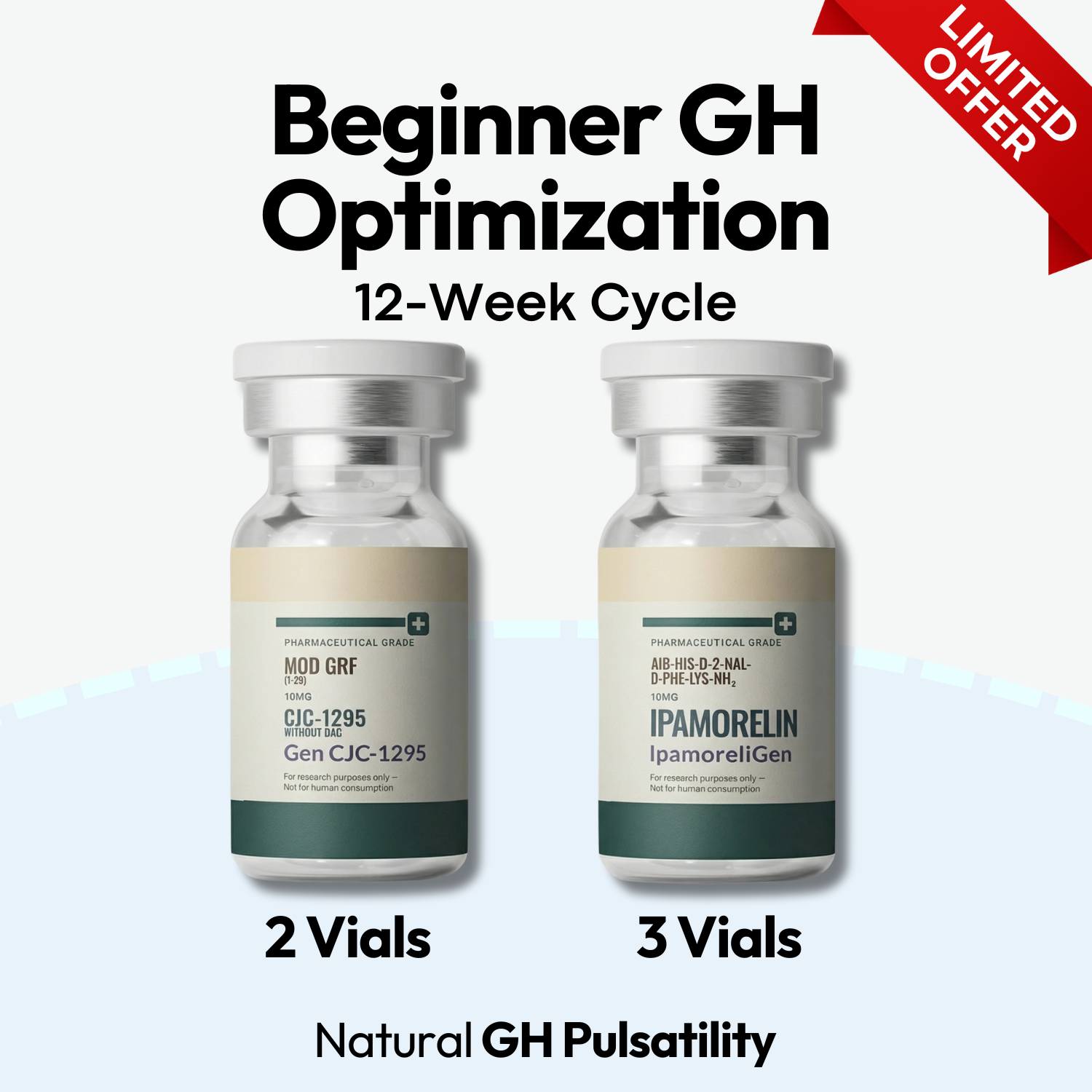

The GH Optimization Research Stack (CJC-1295 no DAC, Ipamorelin) is a beginner-level formulation commonly selected by research teams investigating endogenous growth hormone signaling and pulsatility within controlled experimental models. This stack is designed to support foundational exploration of growth hormone–related pathways without introducing exogenous growth hormone or downstream growth-factor compounds.
By pairing two complementary secretagogues, this formulation provides a structured framework for examining natural growth hormone release dynamics and signaling behavior.
This stack is positioned at the Beginner level within the GH Optimization research framework. It is intended to precede intermediate GH stacks that introduce stronger lipolytic signaling or exogenous growth hormone support. Data generated at this stage commonly informs escalation decisions toward more intensive GH-axis research models.
Includes
- 2 vials of CJC-1295 no DAC (10 mg each)
- 3 vials of Ipamorelin (10 mg each)
This stack pairs two compounds studied for their complementary roles in supporting the body’s natural growth hormone (GH) release system. They work through different, synergistic mechanisms:
- CJC-1295 (no DAC) is researched for its potential to support the natural signaling that initiates GH release, often associated with the frequency of release pulses.
- Ipamorelin is examined for its selective action in stimulating the pituitary gland, which is often associated with the strength or amplitude of those release pulses.
Used together, they create a research model for studying a coordinated approach to natural GH secretion. This combination allows for the investigation of how supporting both the initial trigger and the final release mechanism may influence the overall pattern of endogenous GH output, providing a foundational framework for studying this physiological system.
Mechanism and Research Focus
CJC-1295 is investigated for its interaction with GHRH receptors and its role in stimulating growth hormone release through increased pulse frequency. Ipamorelin is studied for its selective stimulation of growth hormone secretagogue receptors, contributing to pulse amplitude without broad endocrine disruption. In controlled laboratory environments, the combined observation of these mechanisms supports investigation into growth hormone pulsatility, signaling consistency, and downstream pathway engagement.
Key Research Observations
Research has shown this stack may help support the following in non-clinical models:
- Pattern of Release: Studying the natural rhythm, timing, and amount of growth hormone the body releases.
- Natural System Function: Investigating how the body’s own growth hormone production and signaling processes work.
- Response Reliability: Observing whether the body’s reaction to support is consistent and repeatable over time.
- Baseline Understanding: Gathering fundamental data on the growth hormone system as a necessary first step before more advanced research.
Form and Handling
Research-grade peptides supplied in lyophilized powder format. Vials are provided individually and aligned to stack components. Store frozen at approximately −20 °C and protect from light to maintain compound stability throughout the research cycle.
Research Use Only
For laboratory research use only. Not for human or animal consumption, medical use, or therapeutic application.

Reviews
There are no reviews yet.